LA MAS

LA MAS — Health insurance management

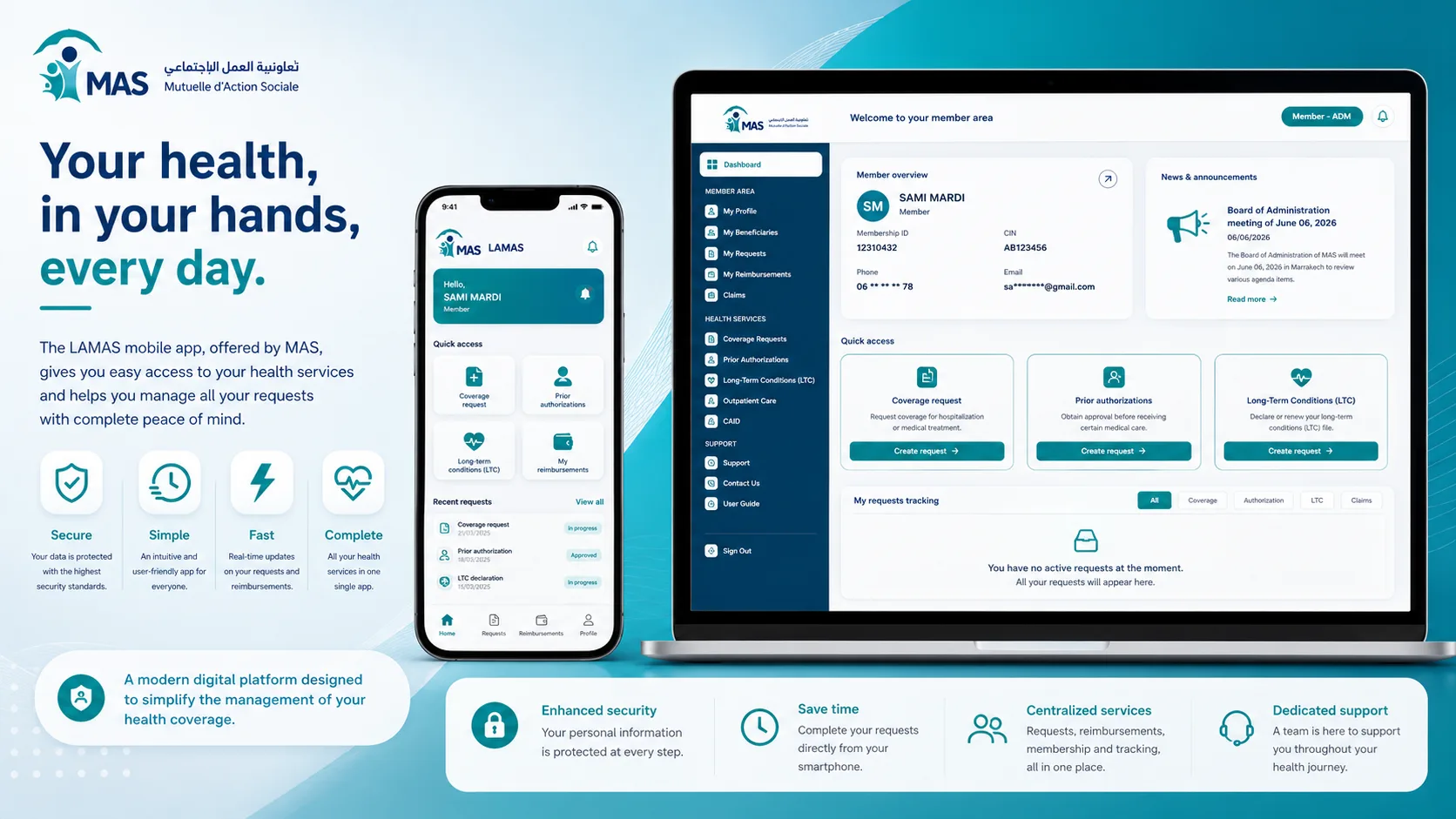
Complete rebuild of the LA MAS website and applications: showcase site, member/partner/back-office portals and a mobile app.

The challenge

LA MAS's website and web application ran on Drupal — a CMS built for content management, not for powering a complex business application. The result was a slow, hard-to-scale, hard-to-secure platform, with two separate authentication systems (one for web, one for mobile) that confused users and added security risk. Outdated design and incomplete, poorly structured features made the experience difficult for members, partners and administrators alike. LA MAS also had no dedicated mobile app at all.

The solution

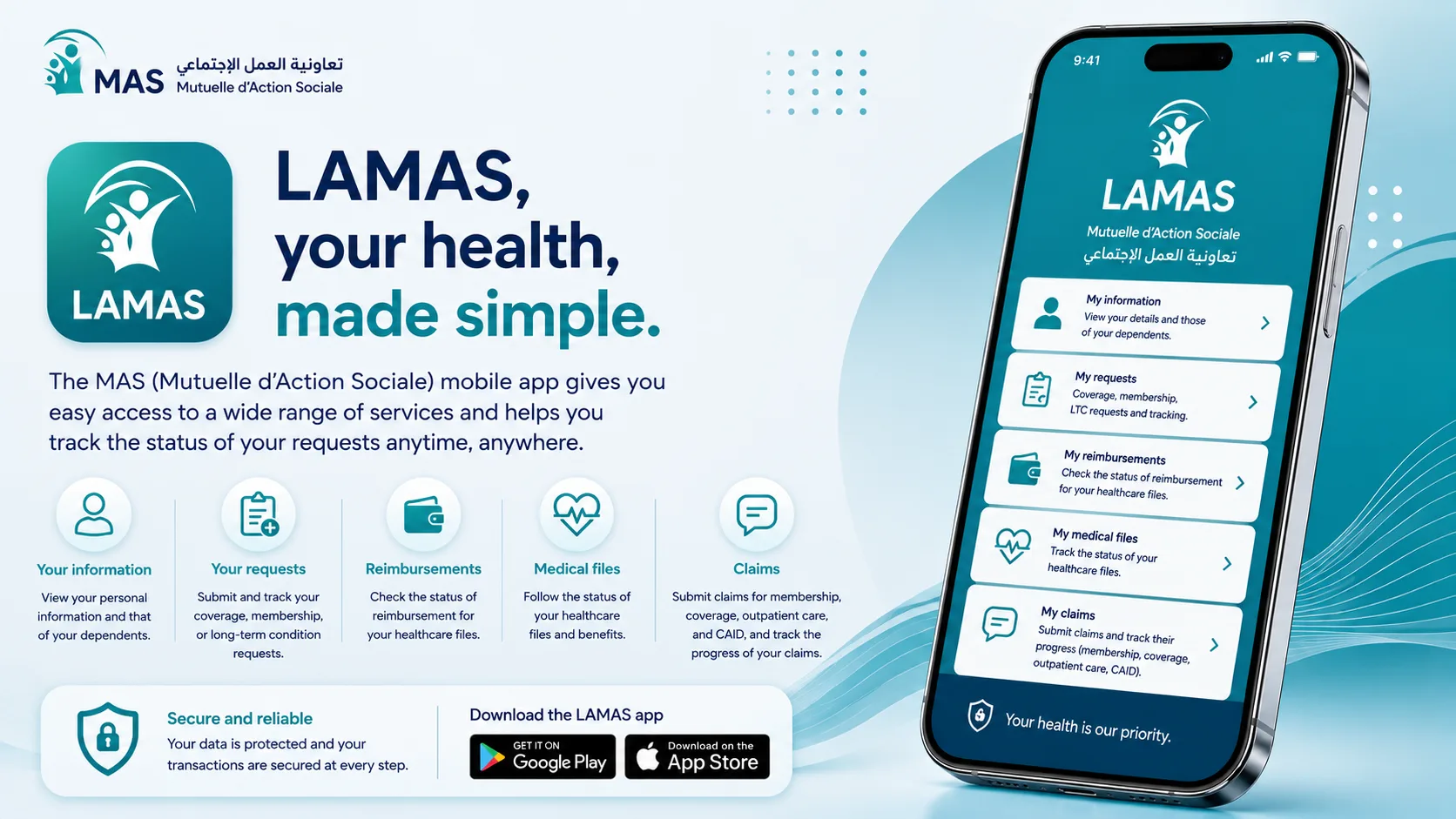
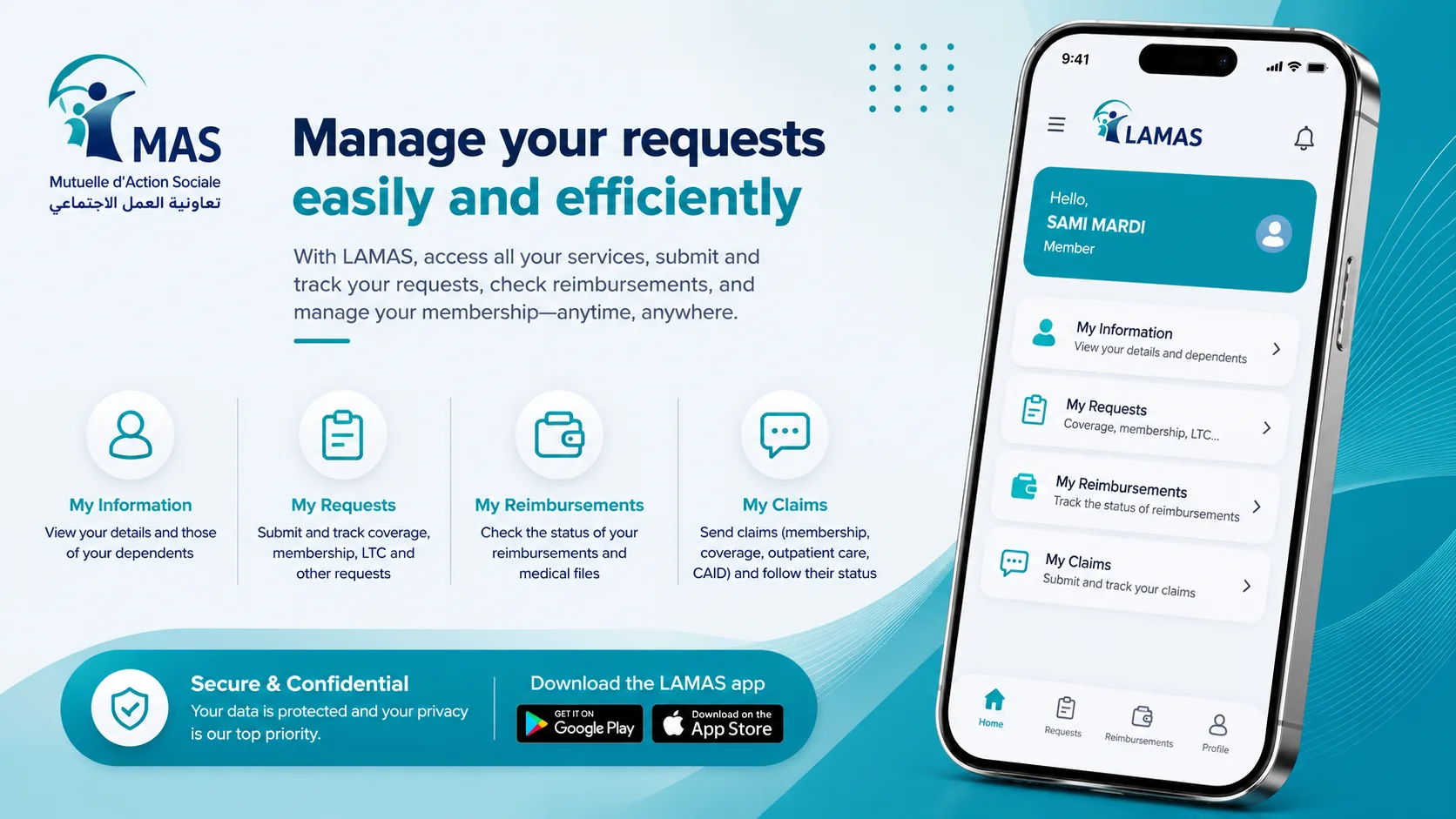
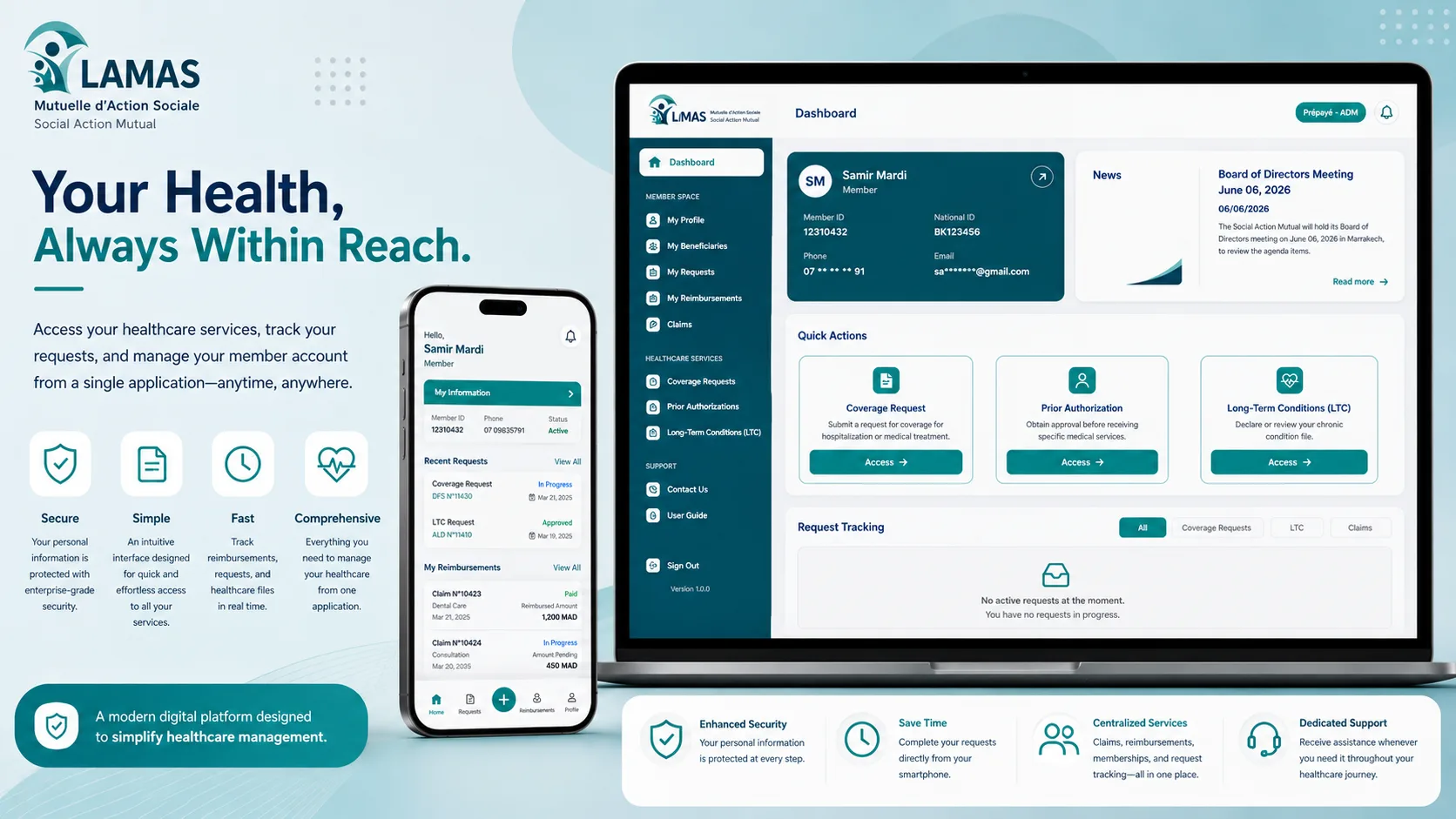
We carried out a complete rebuild with clearly separated responsibilities: a bilingual (French/Arabic) WordPress showcase site, SEO-optimized, handles LA MAS's public presence; three secure Angular business applications — Member Portal, Partner Portal and Back Office (with dedicated Admin, Support and Regional Agent access for files outside Casablanca) — handle day-to-day operations; and a native Flutter mobile app for iOS and Android gives members full mobile access for the first time. A unified authentication system replaces the two separate legacy systems for web and mobile.

This project illustrates our insurance and health funds offer: convention rules applied by a versioned engine, with a member portal and a healthcare provider workspace on a single architecture.

The results

The platform is fully built, tested and validated in a pre-production environment — going live in production is now pending the client's final confirmation. The modular architecture (showcase site, three web applications, mobile app, two dedicated APIs) allows each component to be updated independently without a full re-engineering effort, and the mobile app opens a channel LA MAS never had before.

Methodology and project management

The project was split into three lots delivered in parallel: the showcase site, the connected web spaces (Member, Partner, Back Office) and the mobile app. Each lot followed the same cycle: functional and technical scoping, iterative development, user acceptance testing (UAT), then go-live. Regular check-ins with the LA MAS team allowed the scope to be adjusted along the way, favoring an agile approach over a fixed, upfront specification.

Technical architecture and performance

The platform deliberately combines several technologies, each chosen for its specific use case: WordPress for the showcase site (simple content management for the LA MAS team, native SEO), Angular for the three secure business applications (reactive interfaces, modular architecture), and Flutter for the mobile app (a single codebase for iOS and Android). Two separate Node.js APIs keep backend responsibilities cleanly divided. One notable technical detail: the back office reads — read-only — from LA MAS's existing internal Oracle database, hosted on the client's own servers. This integration respects the data and infrastructure LA MAS already has in place, without duplicating or migrating its legacy system. Security relies on JWT authentication, role-based access control (RBAC), multi-factor authentication, encryption of sensitive data, and GDPR compliance.

Frequently asked questions

Why combine WordPress, Angular and Flutter on the same project?
Each technology is chosen for the job it does best: WordPress for an institutional site the LA MAS team can easily maintain themselves, Angular for secure and complex business applications, Flutter for a native mobile app that performs well on both iOS and Android. This avoids forcing a single tool to cover very different needs.

How do you integrate a new platform with an existing internal system?
When a legacy system (like an internal Oracle database) holds sensitive or critical data, the safest approach is usually a read-only integration through a dedicated API — rather than a full migration, which is risky and costly. That's the approach used for LA MAS: the new system reads existing data without duplicating it or disrupting the system already in place.

Why separate the member, partner and back-office spaces?
Separating interfaces by user type secures sensitive data, tailors the experience to each audience, and lets each space evolve independently without risking regressions elsewhere.

Technologies used

Angular Node.js Flutter MySQL Oracle
Explore the service : Business platforms →

Have a similar project?

Contact us to discuss it.

Chat on WhatsApp