Zido

Zido — Custom Web Portals & Mobile App Ecosystem

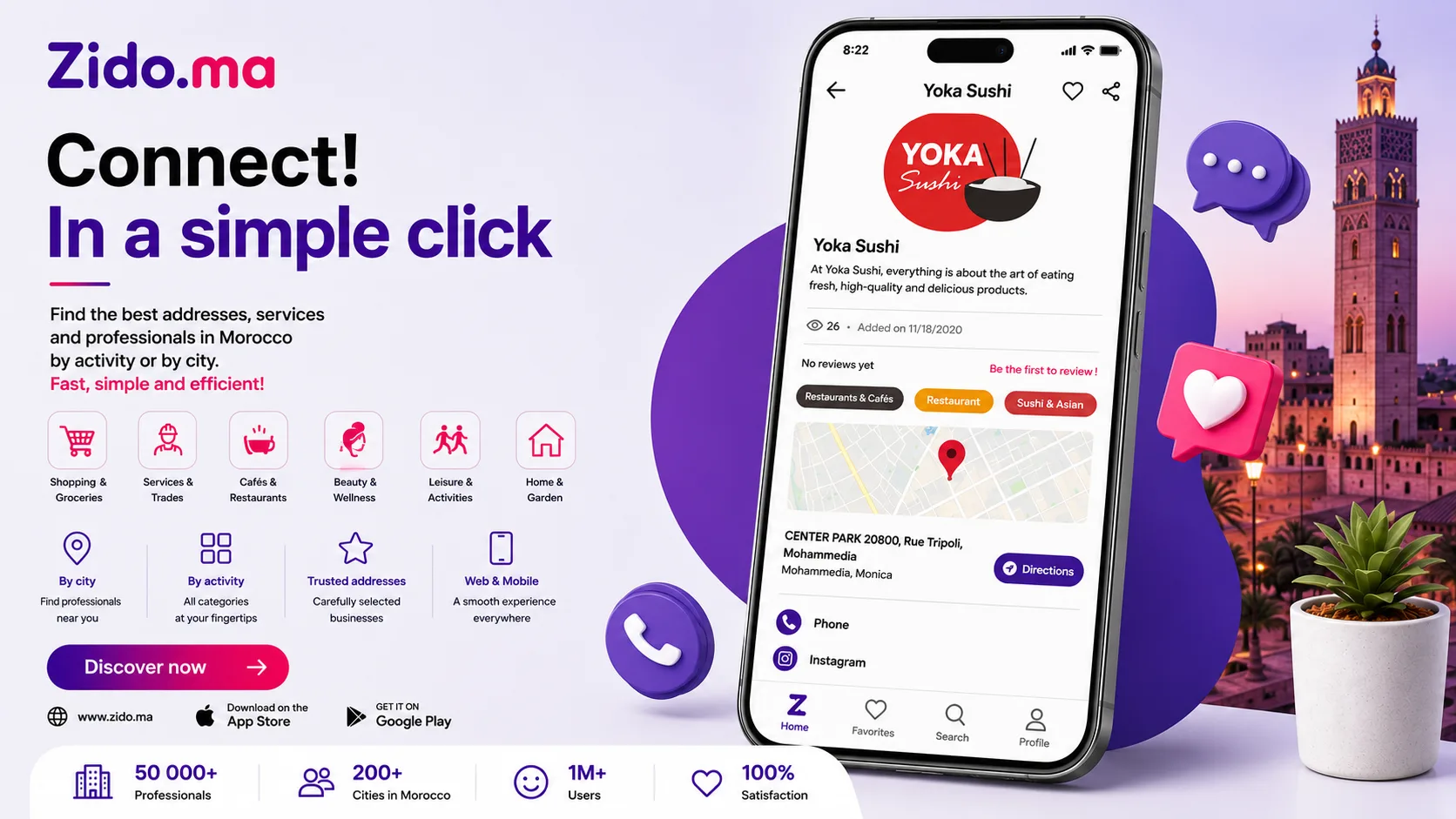
Multi-portal business directory and high-traffic consumer mobile application.

The challenge

Finding a reliable professional nearby was surprisingly hard in the Moroccan market: no centralized digital directory, just scattered word-of-mouth, social media and outdated yellow-pages listings. Professionals had just as little online visibility, with no simple way to showcase their services or manage their own listing. The technical challenge was real: build a platform able to index thousands of professional listings and return geolocated, filtered (category, keyword) search results without slowing down as the catalog grows, while serving three very different audiences — the general public, partner professionals and the admin team — without any one of them slowing down or destabilizing the others.
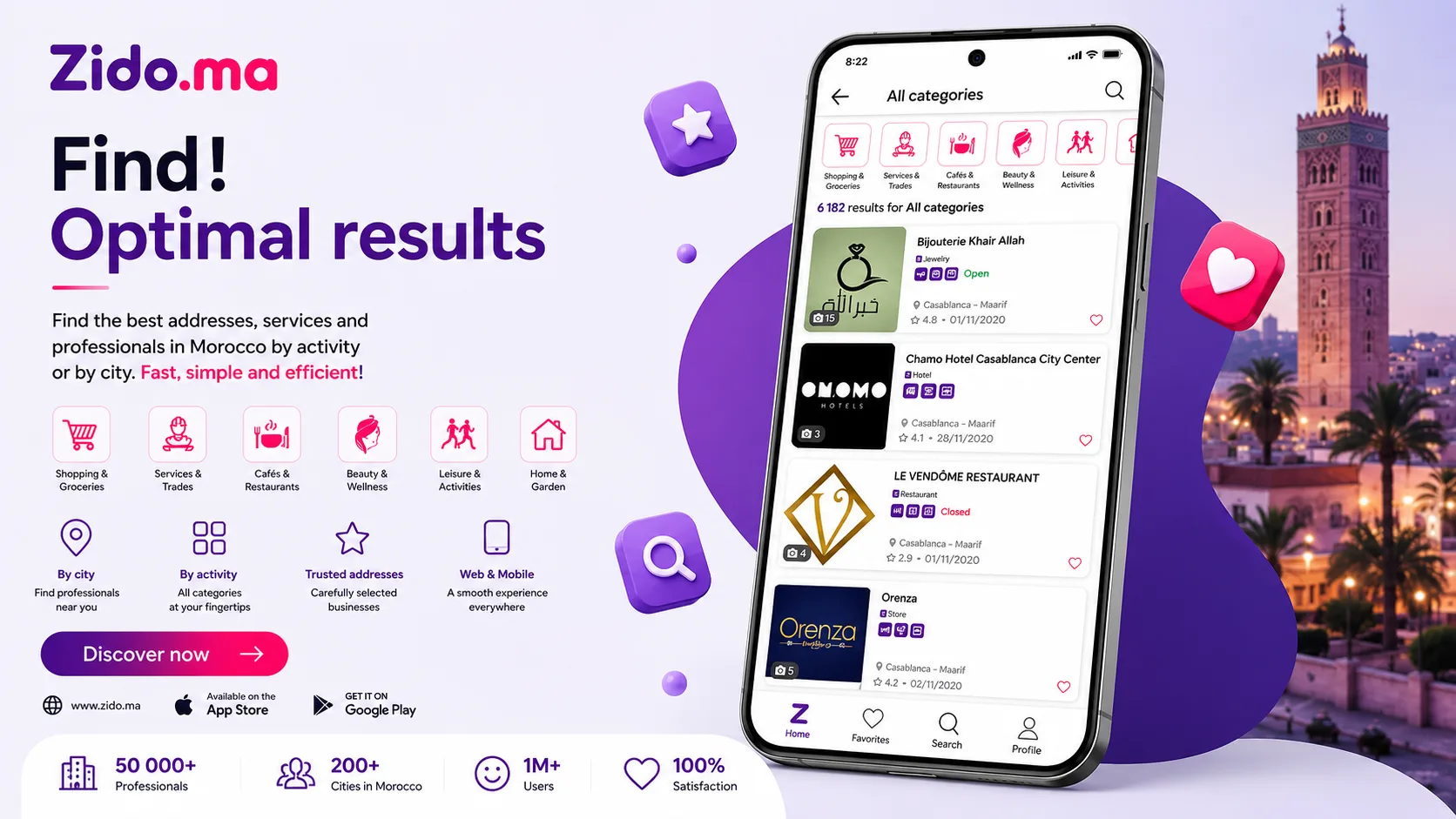
The solution

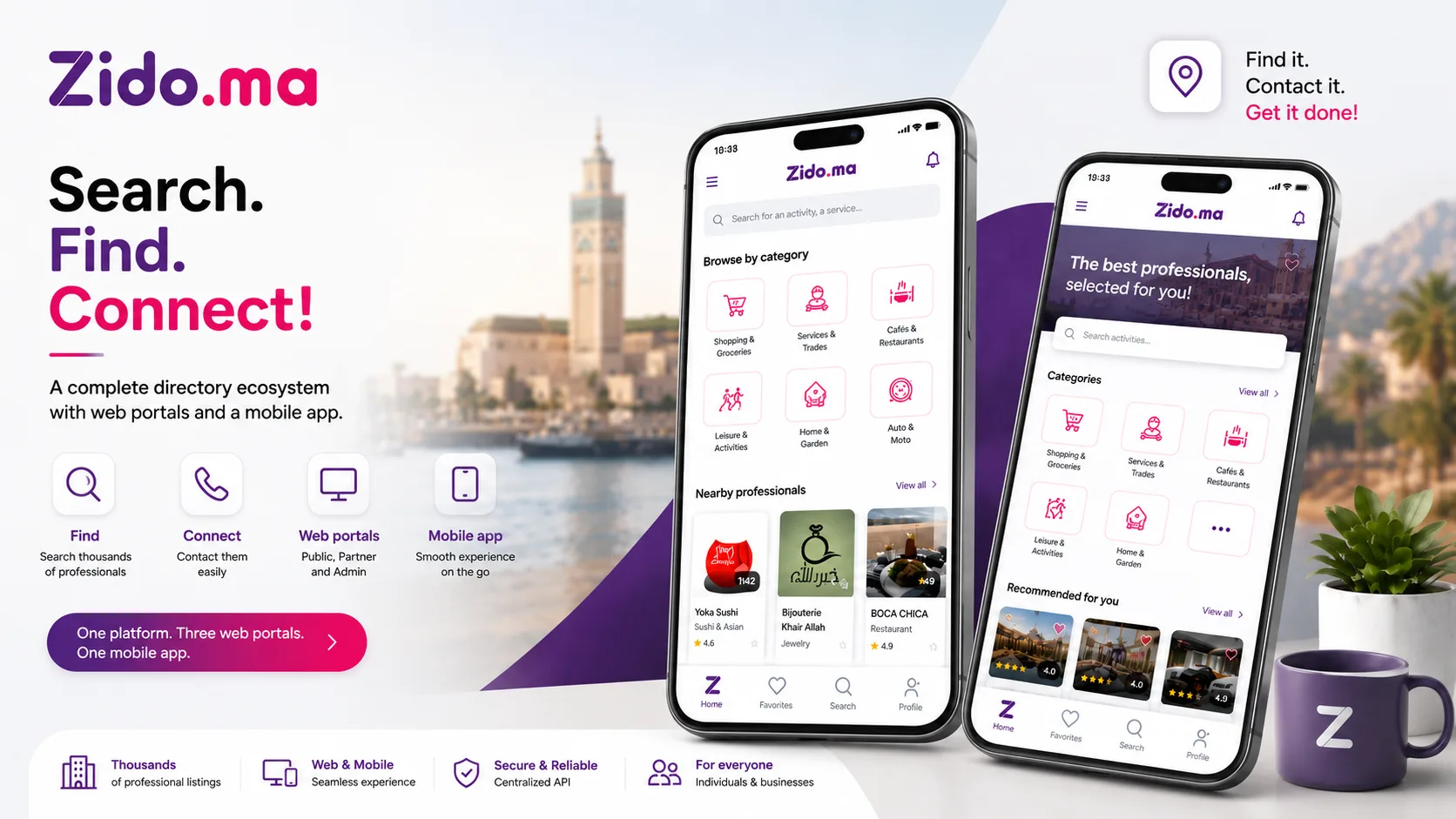
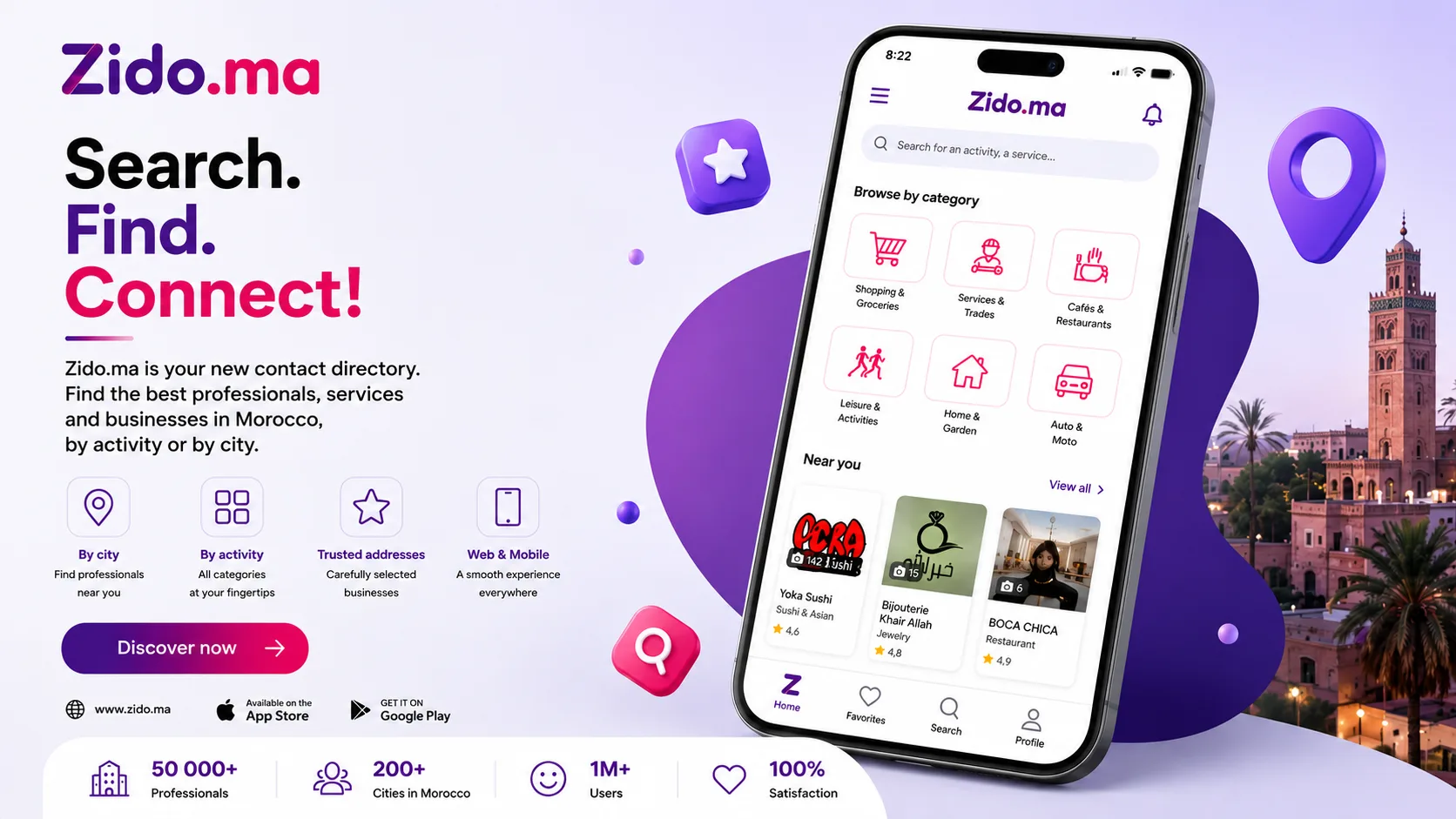
We built a decoupled ecosystem made of four independent building blocks: a public portal for geolocated search, a partner area where each professional manages their own listing independently, an admin back office for moderation and oversight, and an Ionic mobile app offering the same search experience on the go — with native direct-call and geolocation so users can reach a professional in one tap. The three Angular web applications and the mobile app all talk to a single central API (Node.js/MySQL), keeping the search experience consistent no matter which platform someone uses.

This project illustrates our mobile applications offer: an application published on the stores, backed by a back end we built and maintain.

The results

Zido is now a complete, fully operational ecosystem, with fast geolocated search across thousands of professional listings on every platform. The general public gets the same smooth search experience on both a web portal and a native-feel Ionic mobile app, while professionals manage their own listings from a dedicated partner space, and the Zido team runs the whole platform from an independent back office. Decoupling these four interfaces (portal, partner space, back office, mobile app) means each one can evolve independently: adding a mobile-only feature, for example, requires no changes to the web portal or the back office. The concrete result for Zido: a single platform able to absorb catalog growth without any degradation in search response time.

Methodology and project management

Carrying out a project of this scale required rigorous technical project management. We structured the development of the Zido ecosystem using an Agile (Scrum) approach. This methodology allowed us to perfectly align the client's business objectives with the technical constraints. By splitting the project into two-week sprints, we delivered features iteratively: first the central API, then the admin back office, then the public portal, and finally the mobile application. Systematic code reviews and continuous integration (CI/CD) guaranteed the platform's stability at every release, preventing any technical regression on large databases.

Technical architecture and performance

Building a directory covering thousands of professional listings demands flawless backend architecture. The real technical challenge was optimizing database queries.

  • Node.js & MySQL optimization: a highly indexed relational database structure. Complex search queries (combining geospatial filters, activity categories and keywords) are processed in milliseconds by the Node.js API.
  • Web front-end (Angular): dynamic user interfaces with complex state management. To ensure strong SEO, we focused on semantic code structure and load-time optimization (Core Web Vitals) via module lazy loading and image compression.
  • Mobile environment (Ionic): shared codebase while keeping near-native performance. The app talks directly to smartphone hardware (GPS for geolocation, dialer for direct calls) via optimized Cordova/Capacitor plugins.

Frequently asked questions

How long does it take to build a directory/connection platform like Zido?
Building a complete ecosystem (API, web portals, mobile app) generally takes from 4 months of work, depending on the complexity of the filtering features, search algorithms and partner subscription systems.

Why separate the back office from the public portal?
Separating the interfaces (decoupling) secures sensitive data, optimizes the performance of the public portal (which receives the most traffic), and makes it easier to maintain each module independently.

How do you keep the mobile app fast with that much data?
The key is server-side pagination and the Ionic app's caching system. Instead of loading tens of thousands of listings at once, the app only fetches the data strictly needed for what the user sees immediately, keeping navigation ultra-smooth.

Technologies used

Angular Node.js Ionic MySQL
Explore the service : Business platforms →

Have a similar project?

Contact us to discuss it.

Chat on WhatsApp