E-invoicing in Morocco: what is actually required today
As of 17 November 2026, we found no published text that already makes DGI-validated e-invoicing mandatory. What is required today, what has been announced, and how to prepare your software without betting on dates.
No: as of 17 November 2026, we found no published decree that already makes it mandatory to issue electronic invoices validated by the DGI (the Moroccan tax administration; to be confirmed in the Bulletin officiel on the day you read this). What is required today is invoices numbered in a continuous series, produced by a computer system or taken from a pre-numbered book, with the details required by article 145 of the General Tax Code (CGI), and accounts kept in electronic form.
Yet the subject circulates everywhere with precise dates and thresholds. This article separates what is written in the texts from what has been announced, cites its sources, and explains how to prepare your software without betting on a timetable that has not yet been published.
Updated on 17 November 2026. General information, not tax or legal advice: for your situation, consult your chartered accountant and the texts published by the DGI.
What does the law say about invoices today?
Three provisions of the General Tax Code (CGI) matter here:
- Article 145-III: taxpayers subject to corporate tax (IS) or income tax (IR) on their business income, as well as those liable for VAT, must issue invoices that are “pre-numbered and taken from a book or produced by a computer system in a continuous series” (our translation). Source: DGI, circular note No. 728 on the 2018 finance law, section R.
- Article 145-IX, introduced by the 2018 finance law: it establishes “progressively” the obligation, for taxpayers in sectors “to be defined by regulation”, to use a computerised invoicing system meeting technical criteria set by the administration. Source: the same circular note No. 728, DGI. In other words, the principle has existed since 2018, but applying it depends on an implementing regulation.
- Article 145-I: accounts must be kept in electronic form. The 2026 finance law removed the reference to an implementing regulation that was to set the criteria; the obligation therefore now applies “in accordance with the legislation and regulations in force”. Source: DGI, circular note No. 737 on the tax measures of finance law No. 50-25 for 2026 (listed on finances.gov.ma as of 10 March 2026).
The same note No. 737 also states that all taxpayers must now hold an email address of their choice, registered with the DGI via SIMPL, to receive notifications (article 145-X). As we read it, it contains no measure setting a start date for e-invoicing.
The mandatory invoice details (seller identity, tax identifier, business tax number, ICE of the seller and of the customer, date, description, quantities, prices, VAT amount or exemption statement, payment terms) fall under article 145-III. We take them from a practitioner’s summary: the exact list is to be confirmed against the current CGI text, downloadable from www.tax.gov.ma.
What has been announced but is not yet in force?
In April 2026, the Director General of Taxes publicly presented the reform at an event organised by Médias24. According to the report published by Sage Morocco on 14 May 2026 (secondary source):
- Morocco would adopt a prior-validation model: each invoice would pass through an administration platform before being considered issued;
- the rollout would be gradual, starting with business-to-business exchanges (B2B), with B2C not planned at this stage;
- a draft implementing decree had reportedly been sent to the General Secretariat of the Government;
- a free online tool would be offered to small businesses, and a connection by data exchange (EDI) to those with an ERP.
To our knowledge, none of this has been published in the Bulletin officiel as of the date of this article. The thresholds going around (for example 200 million DH of turnover for a first wave) and the dates per wave do not come from any official text we have been able to read: treat them as assumptions. The name and address of the future platform also vary between sources; wait until they appear on www.tax.gov.ma.
The 2027 finance bill, presented to Parliament on 23 October 2026, would not amend article 145 according to a secondary analysis we read; this is to be confirmed against the text as passed.
How can you tell whether a text has changed since this article?
Three sources are authoritative, in this order:
- The Bulletin officiel: it is the publication of a decree or order that makes the obligation applicable, with its dates and thresholds.
- The DGI website, www.tax.gov.ma: circular notes, the up-to-date CGI, announcements and, when the time comes, the technical specifications.
- Your chartered accountant, who reads these texts for your case.
Be wary of pages announcing an “obligation from 1 July” without citing a text: many are written by vendors with software to sell. Ours has an interest too, which is why we cite our sources.
What should you do in your software now?
Without waiting for the specifications, you can already get your invoicing ready to connect quickly when the time comes. This work is useful whatever the final date:
- Continuous, tamper-proof numbering: no gaps, no deletions; a wrong invoice is cancelled with a credit note.
- Structured data: the customer’s ICE, VAT rates per line and exemption statements must be fields, not free text in a PDF.
- A clean customer master file: verified ICE numbers, complete addresses. This is often the longest piece of work.
- A single exit point: all invoices come out of the same module, which will make it possible to add a connector to the administration’s platform without touching the rest.
- Usable electronic accounts, which article 145-I already requires.
What not to do: build a connector today to a platform whose format has not been published. You would pay twice.
How much does bringing your invoicing into line cost?
| Situation (excl. VAT) | Range | Source |
|---|---|---|
| Diagnostic of your current invoicing | 12,000 to 30,000 DH | Published rates |
| Custom invoicing module (numbering, credit notes, structured data, export) | 40,000 to 180,000 DH | Published rates (business module) |
| AI reading of supplier invoices | 18,000 to 200,000 DH | Published rates (AI integration) |
| Connector to the future DGI platform | Cannot be priced until the specifications are published | Digi4 estimate |
Assumptions: a company already invoicing from software; the low end of the ranges is an adaptation of an existing tool, the high end a complete module linked to accounting and stock. Details on our pricing page. These are orders of magnitude, not quotes.
Off-the-shelf ERP, Odoo or custom: who will be ready?
If you use an off-the-shelf ERP or invoicing software, compliance is first the job of its vendor or your integrator: ask them in writing how they plan to follow the text once it is published. This is often the simplest route, and for standard invoicing we recommend it. Odoo, for example, is reasonable for a standard scope; our custom ERP page compares the two options honestly, with three-year costs.
If your invoicing lives in software developed for you, it is your provider who will have to add the connector. If that provider is gone, read our article on taking over an abandoned application. For an example of a management platform we built, with several roles (member portal, healthcare partner area, back office for administrators), see the LA MAS case study.
Frequently asked questions
Is a PDF invoice sent by email an electronic invoice?
Not in the sense of the announced reform, which targets structured invoices validated by the administration. Today, a PDF issued by software that complies with article 145 remains a valid invoice, provided it carries the mandatory details.
Are auto-entrepreneurs affected?
According to the practitioners’ summaries we read, article 145-XI exempts auto-entrepreneurs and taxpayers under the single professional contribution (CPU) regime from certain article 145 obligations. To be confirmed with your accountant against the text in force.
Are there already penalties for not using e-invoicing?
We found no specific penalty in force linked to e-invoicing. Existing penalties concern the current invoicing and bookkeeping obligations.
When should you start?
Data clean-up and numbering can start now. The connector will wait for the specifications to be published.
Related articles
Compliance & regulation
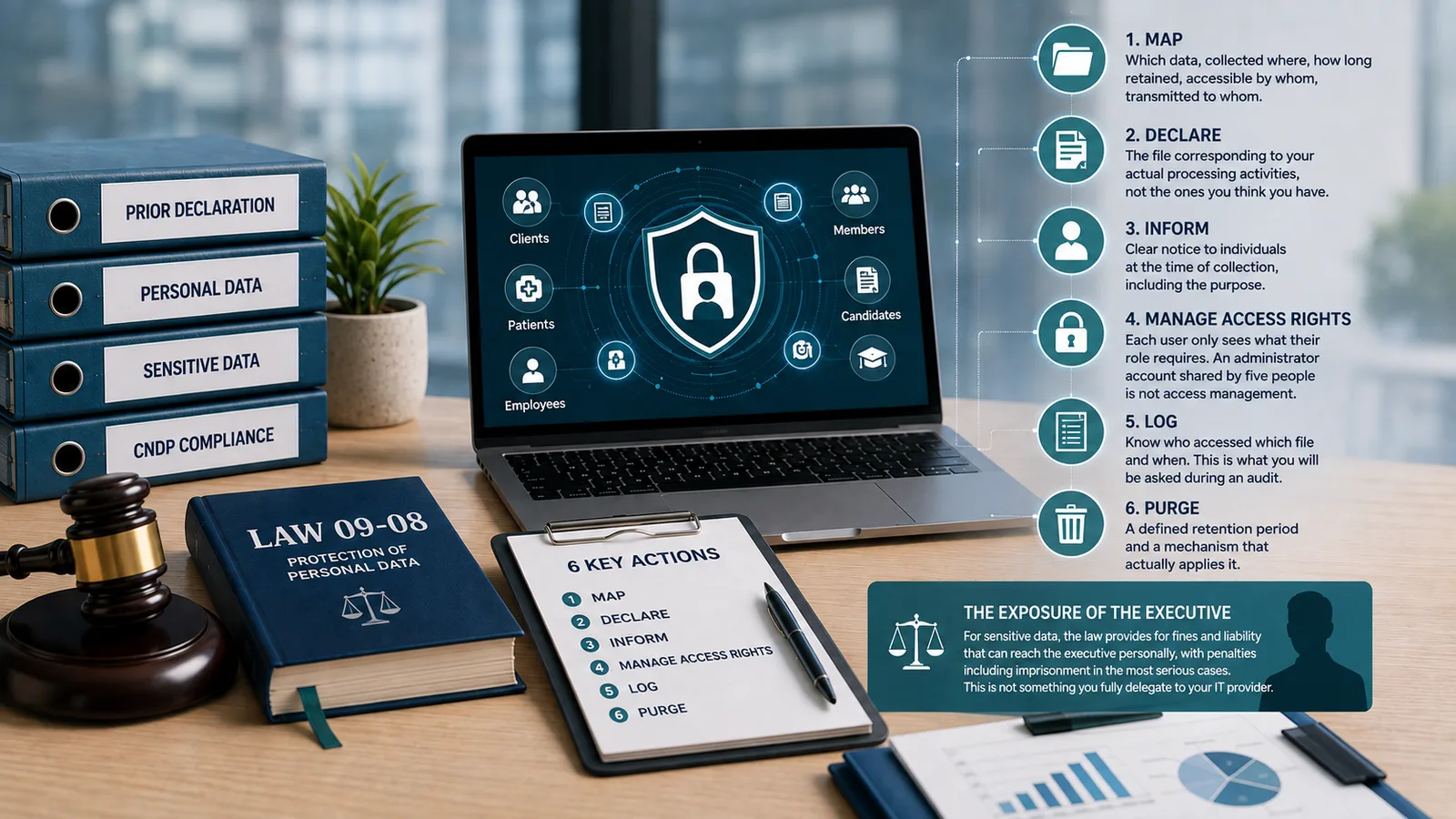
CNDP compliance: what a Moroccan company actually has to do
Morocco's data-protection authority has stepped up enforcement and explicitly names healthcare, pharmaceuticals, hospitality, e-commerce and higher education. Here are the concrete obligations — and the director's personal exposure.
Compliance & regulation
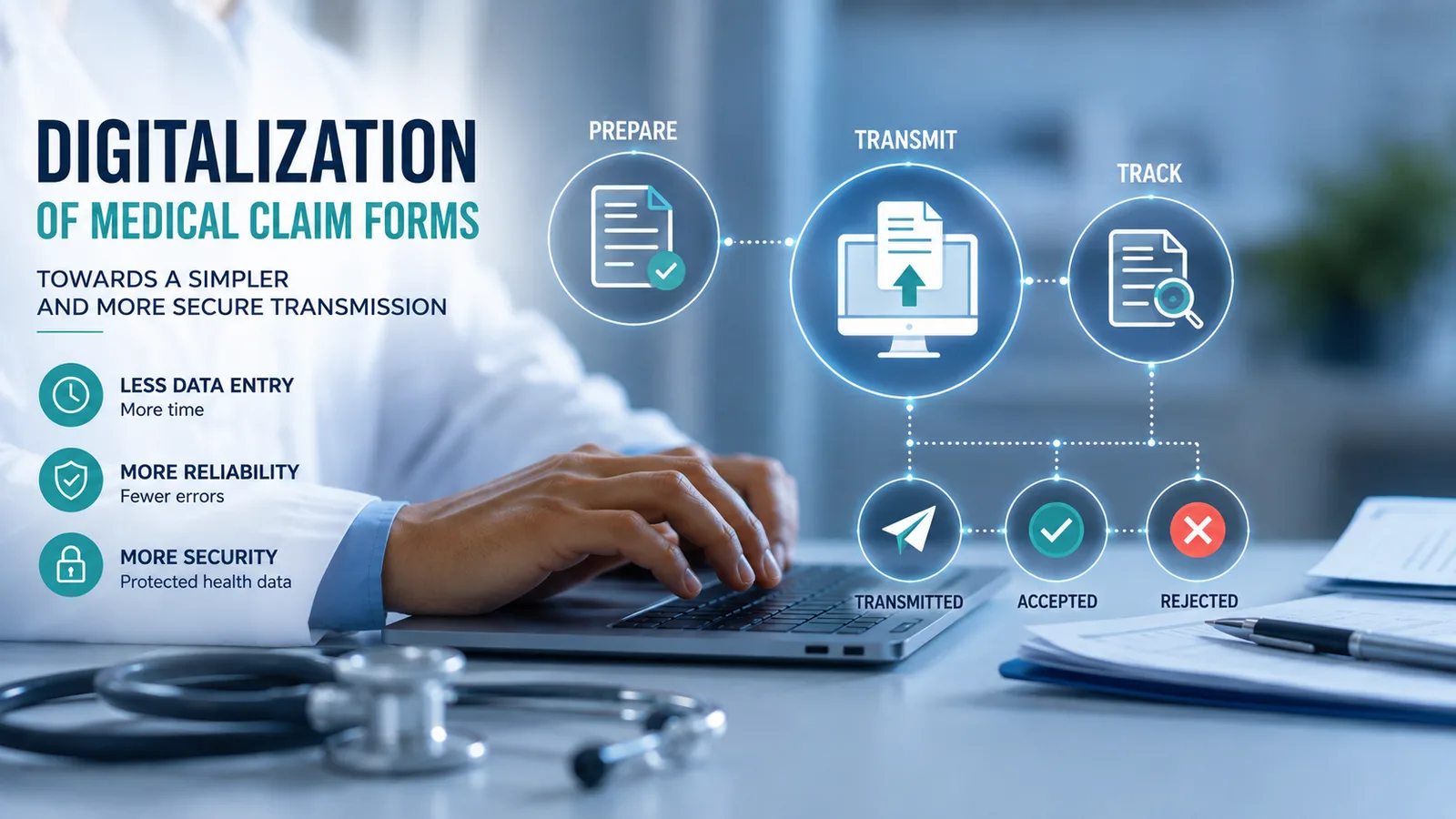
CNSS electronic care claims: what changes for clinics and laboratories in Morocco
Electronic submission is becoming the norm for doctors, pharmacists and laboratories. The important detail: it can happen through the insurer's portal, or through your own software.
Compliance & regulation
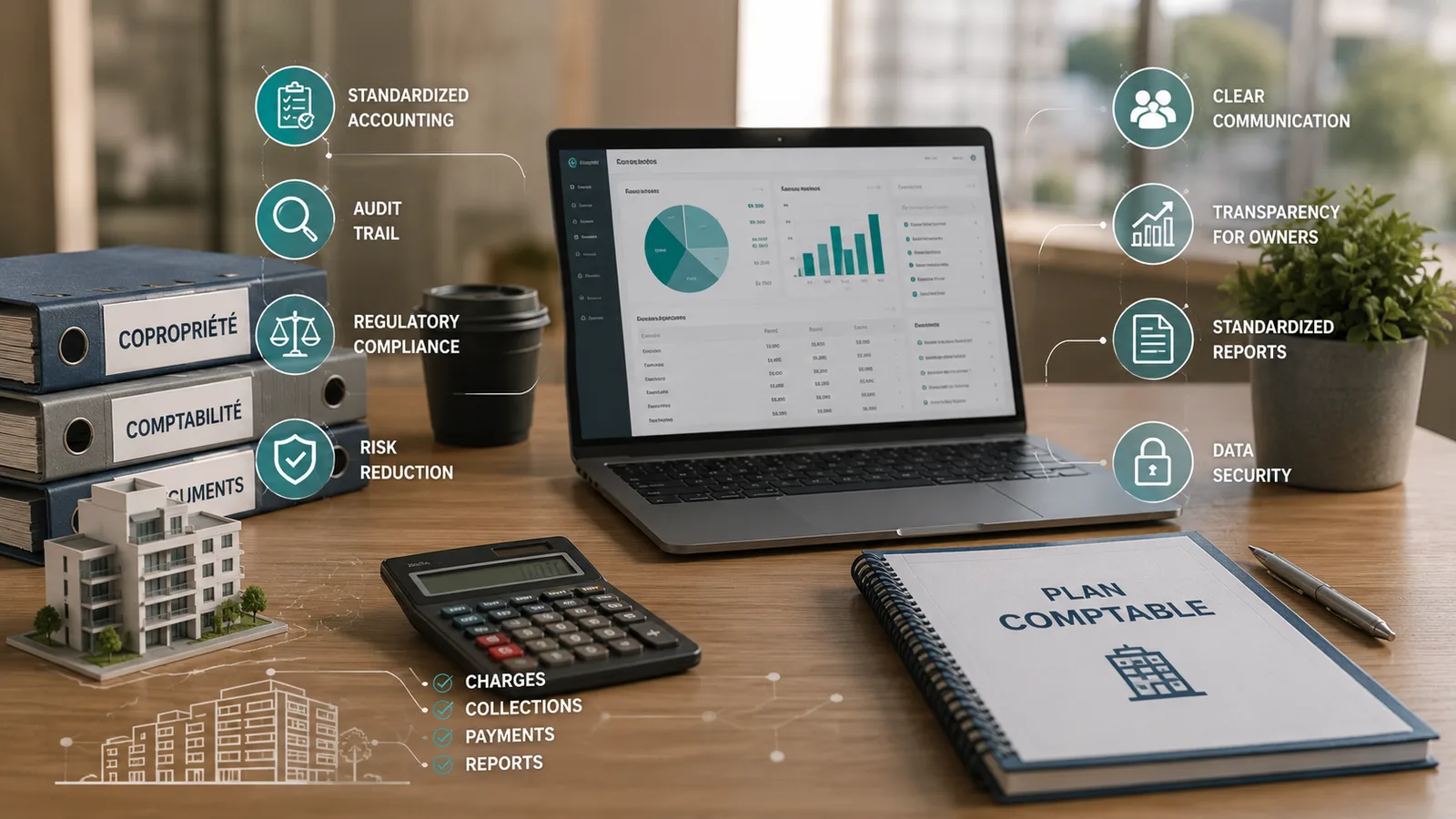
Condominium accounting in Morocco: what decree 2.23.700 requires
A decree published in the official bulletin requires standardised accounting from condominium managers, with obligations that increase according to the level of charges managed.
Newsletter
Get our upcoming articles straight to your inbox.